Pad Girls! Attack of the 21st-Century Falsies
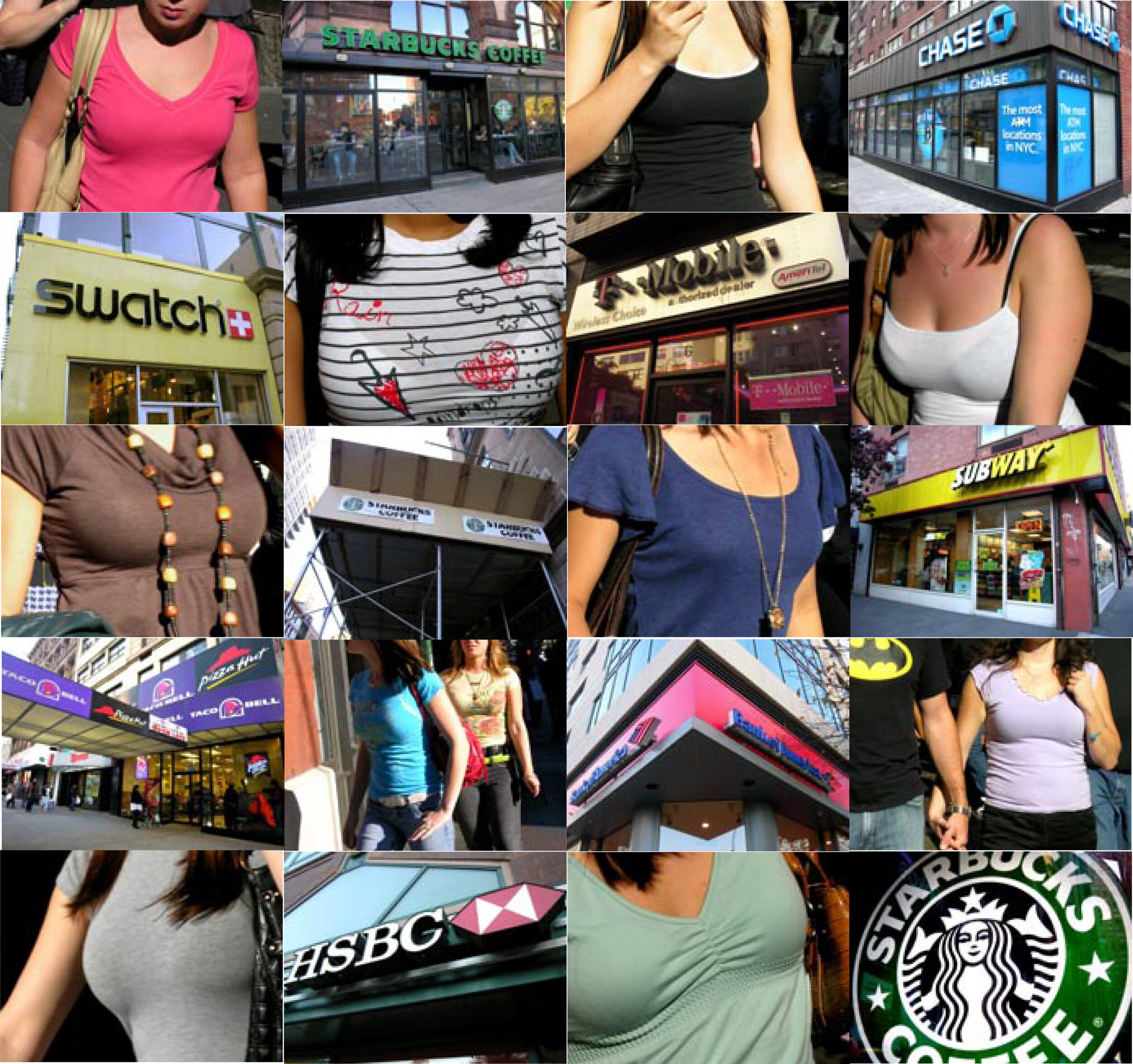
New York City’s increasingly homogenous streets and breasts. Photo: Nina Roberts
Published in The New York Observer on December 18, 2007
To the long list of things making New York City more homogenous—funky brownstones razed in preparation for high-rise condos, chain-store franchises displacing neighborhood favorites—add women’s breasts.
Have you noticed? Increasingly, the ladies of this town have been sporting remarkably similar pairs of perfect, pert globes: rounder, higher and larger than ever before. There has been an absence of breast individuality such as lace, seams, overflow, jiggle, signs of gravitational pull and, most notably, nipple.
The flawless orbs that have been parading around the city are achieved by strapping on a “lined,” “T-shirt,” or “contour” bra. These are marketing terms for what is essentially a modern padded bra. This is not the quilted number of years past, but rather a smooth, immaculate device with foam-infused breast cups. Each cup is preformed, creepily having the same shape on or off the body. These lined bras have eased out simple cotton, silk or lace bras, and comprise about 90 to 95 percent of the bras for sale in Victoria’s Secret, the Gap, or any of the mainstream department stores.
“I always try and push them, because it gives a better lift and you don’t see the nipples peeking through,” said Heather, a young lingerie saleswomen in mod makeup, a black mini-dress and furry boots who was working at Saks Fifth Avenue’s lingerie department the other day, holding a hanger with two silky but sturdy cups dangling from straps. Her colleague, Carolina, concurred: “A lot of women have problems with their”—and here her voice dropped to a whisper—“nipples showing.”
Amid the endless racks of protruding breast cups and in the Victoria’s Secret store on lower Fifth Avenue, saleswomen Chrystal Toppin explained: “These bras hide the nipples. It is a trend. A lot of women don’t want to protrude and attract the wrong kind of attention.”
For women who have never particularly noticed or cared if a little nipple shows when a cool breeze passes, or haven’t wanted to mask their natural shape, this trend has made bra-shopping a tedious, expensive affair. And many men are baffled.“It’s absurd!” exclaimed Luca, a handsome Italian mathematician who makes ample time for socializing. “Women here have their breasts on a platter, but then no nipple.” Luca theorized that women in New York City are caught in a negative-reinforcement loop. “Manufactures see that a sizable population want this kind of bra, so now there isn’t anything else to buy. Women have started to believe shop assistants when they suggest hiding the nipple is good.”
ASSET MANAGEMENT
It’s not just the camouflage of this crucial bit of tissue that is confounding men, but the illusion of general greater endowment, perhaps unseen since the falsies of the 1950’s, that these underpinnings universally impart. “I’ve been disappointed when I’ve taken one of those bras off,” said Christian, a 45-year-old artist-photographer who declared himself “passionate” about the subject. He went on: “I’ve had to try and hide my look of surprise. It’s not a deal breaker or anything, but the shape, the size, is many times different than one might have anticipated.”
When asked if the lined bra has made the breasts of New York City lose their uniqueness, department store saleswomen chorused no. They countered that each design is cut differently, offering a different breast shape. Yet The Observer’s investigation suggests that the only “difference” amounted to the perfect mounds being pushed higher, lower, inward or outward.
What’s curious is the lack of protest by women who don’t want their breasts to look like everyone else’s. The average bra buyer is seemingly oblivious or indifferent to breast homogenization. “I don’t know, I’ve never really thought about it, “ said one young woman at the Gap, shrugging her shoulders. “I don’t think too many women go around analyzing breasts.”
Some women have even made the conscious choice to wear the lined bra, such as a 38-year-old petite, buxom portfolio strategist who declined to give her name as she works (oh the irony!) in a major asset management company. She unapologetically called her breasts “corporate boobs,” and likened her bras to shields. “I don’t want to walk by the guys in sales and feel vulnerable,” she said with a reluctant laugh. “I think it’s about control. You can’t control your nipples. I hated days when I’d catch a reflection of myself and see my nipples. I felt betrayed.”
Even Calvin Klein, a company known since its inception for sexy, edgy designs and advertising, has its version of the lined bra. In a sleek, lustrous showroom at Calvin Klein Underwear in the garment district, VP of design Mireille Gindrey noted that the company’s best-selling bra in the U.S. has indeed been the smooth, padded cup. “I do think it’s cultural,” said Ms. Gindrey, originally from France, sitting next to Emily Bohonos, director of marketing, who nodded in agreement. “It has to do with modesty and comfort. But you can achieve an ultra-sexy bra, even if it’s simple and smooth.”
Both of the elegantly dressed women animatedly described intriguing global marketing bra trends but grew uncomfortably silent when asked why women in New York, a city that carries a reputation for individuality, seem to be content with generic breasts.
“Wrong attention,” Ms. Gindrey finally said quietly, adding that here, attention can be a form of aggression. “While in France, if a man gives a look, I might think, ‘Oh, I must look good today!’” she laughed.
Ms. Bohonos added that many of today’s residents of New York are interested in luxury living and “trading up,” contributing to the general feeling of conformity, including the breast. Think of it as the W hotelization of the decolletage.
PROTESTING THE PADDING
But thankfully, New York City still has corners—and cleavage—that gentrification has yet to reach.
In her basement studio-showroom on West 15th Street, surrounded by hanging lace bras and garter belts in fluorescent colors, amid the sounds of sewing machines churning away, rebel lingerie designer Deborah Marquit reflected on her philosophy of simply decorating a woman’s figure and her outright rejection of designing a padded bra.
“I love making lacy, sexy bras for a 32A chest,” Ms. Marquit said. “I see the woman say, ‘I love it. I never thought I could wear a bra like this!’ There is something about flaws—having a little cellulite, wrinkles, being a little fat, it’s way more sexy. Do I think all breasts are beautiful? Honestly, no. But you can beautify what you have.”
Ms. Marquit, 53, a native New Yorker, has been designing lingerie for 23 years, and her collections have sold at Barneys, among other high-end stores. She said that the proliferation of padded bras has to do with cheap manufacturing costs—they are almost all made in China—but suggested also that it’s a reflection of the current state of our culture.“My feeling is that these days, rather than someone like Janis Joplin being revered, idolized, it’s more about the shoe or the bag of the moment,” she said. “It’s about labels, names, branding. Everyone has their hair straightened, the perfect jeans, the right cellphone and accessories. It’s almost like New York is turning into L.A.; there is a lack of acceptance of natural self.” Though New York women do not appear to be embracing surgical implants with the same zeal as their sisters in the West … yet?
“I see a lot of women’s bodies; there was this one beautiful woman here recently, and she wanted implants,” said Ms. Marquit, dressed in all black, with unruly red hair. “I told her not to come back if she got them.”
Holly Copeland, a former Rockette who’s now a stylist, has asked her models to take their padded bras off when styling fashion shoots. “But when I’ve worked with celebrities, I always have to have one on hand,” she said. “It’s almost taboo to have any of that showing.” Moreover, she remarked, “everyone wants to have bigger boobs. Victoria’s Secret makes it easy to get big boobs without surgery.”
But on the front lines of bra sales at La Petite Coquette, the downtown lingerie shop with a loyal following, a recent, hopeful shift has been felt by the sales staff. “Women are tired of looking like everyone else,” said proprietor Rebecca Apsan in a husky voice. She was surrounded by lacy bras, panties, silken robes, and boudoir-like props.“There is a decline now,” in the padded bra, Ms. Apsan added, “because women want to be more natural. Women are doing something underneath that makes them feel feminine.”
“We’re still selling them,” conceded store manager Martina Solej, “but I find lately, women want to be sexier. It’s changing little by little.” Ms. Solej recounted a client she had earlier that day, barely able to contain her joy. A businesswoman had renounced her padded bra, literally throwing it out in the garbage. The client made huge waves in the store when, according to Ms. Solej and many of the saleswomen, she declared, “‘Screw it! Give me a lacy bra. I’m going to let them see that, yeah, I might be the only woman here, and I’m professional—and I’m wearing a lace bra!’”