From Digital Nomad to Baklava Salesman
Roy Donk was running his virtual digital marketing firm when a spur-of-the-moment decision at a Phish concert changed his life.
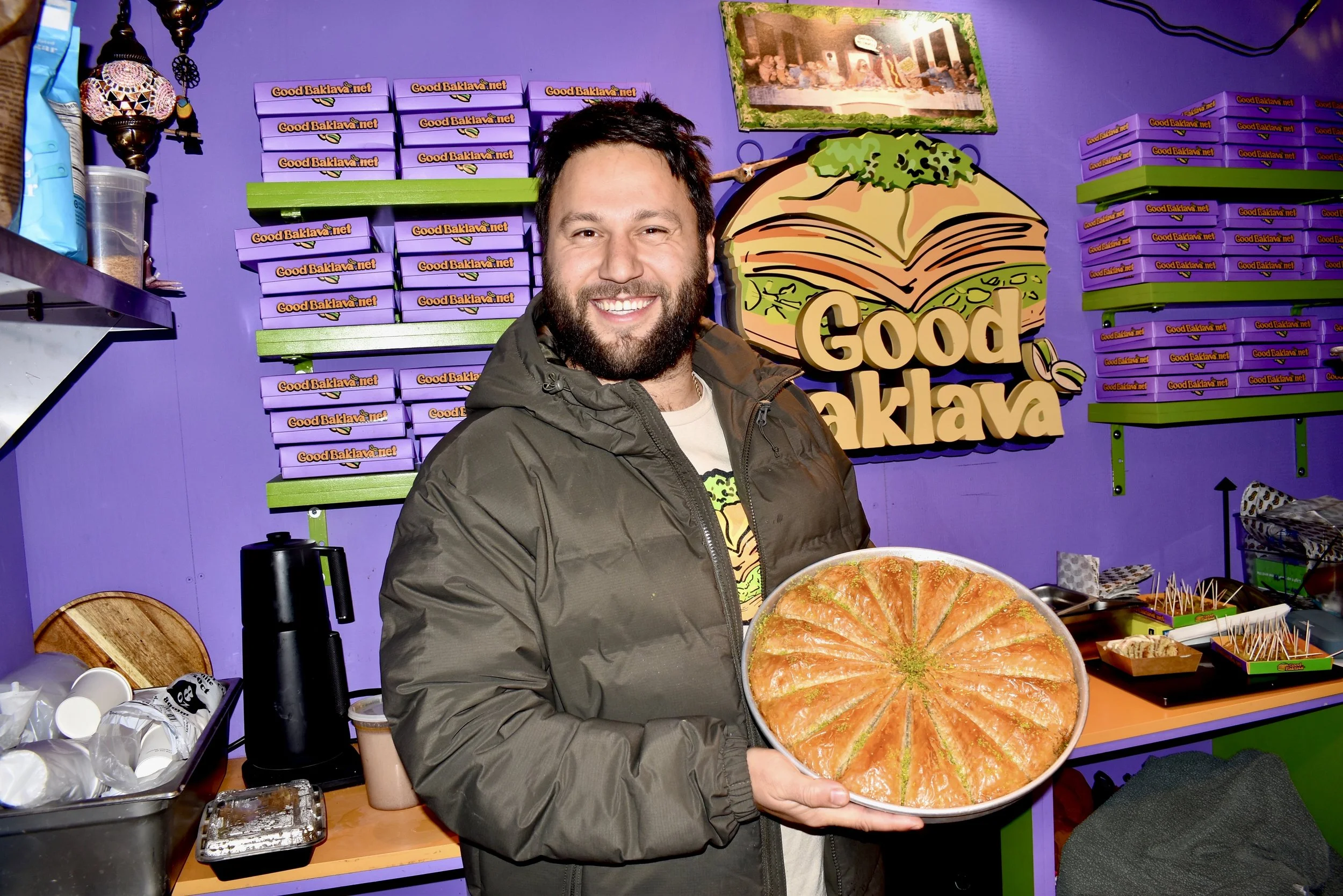
Roy Donk at Macy’s Holiday Square Market. Photo: Nina Roberts
Published in The Unplanned Pivot on February 3, 2026
Roy Donk was the ultimate digital nomad, for years running his digital marketing company remotely from California, Mexico and Asia while traveling the globe to attend Phish concerts. Before a 2021 Phish show in Mountain View, California, he spotted Turkish baklava in a Middle Eastern grocery store/burrito spot. He decided to buy and re-sell the baklava to concert goers in order to replenish his evaporating funds. Donk began earning enough money selling baklava at Phish concerts that it became a regular side hustle. Fast forward several years. Donk was couch surfing in New York City, selling baklava in Central Park in Manhattan and Prospect Park in Brooklyn, earning as much as $1,000 a day.
By April 2025 Donk decided to go full force and launch his business, Good Baklava. He recently expanded into a booth at the Macy’s Holiday Square Market in New York City that included a $15 baklava hot chocolate. So how did a New Jersey guy with no connection to Turkey become a Turkish baklava salesman?
Nina Roberts: Going back to the Phish concerts, how and why did you start selling baklava at those shows in 2021?
Roy Donk: It just happened in the spur of a moment. I was in a grocery store with a friend figuring out how to survive on a Phish tour and not go completely broke. I had to figure out a way to stay on tour. Baklava just happened to pop up in front of us and I suggested, “How about this?”
I woke up that morning saying, “All right, how do we make money?” Instead of, “How do we start a baklava company?”
NR: Phish concert goers bought it?
RD: It was an immediate hit. People are like, “Wait, what do you mean, you’re selling baklava?” I’m like, “I haven’t really thought it through yet, but yes, I am selling baklava.”
NR: When did you know you wanted to sell baklava as a real business?
RD: In between travels, crashing on friends’ couches in The States, I decided one weekend to sell baklava in Central Park. I saw 100,000 people on Sheep Meadow, packed to the brim. I sold all three trays. I’m like, “Let’s try this again tomorrow.” Every single day I sold out. The best part was a few people said, “Oh, you’re the guy from Phish.”
Then I went to Prospect Park. People in Brooklyn were like, “Give it to me,” “Give me that, I want it.” I still had my marketing job, this was my weekend side hustle. I made good money.
NR: How much were you making from baklava sales?
RD: Some days, a thousand bucks profit. I went to my best friend who’s now my business partner, and I’m like, “Dude, we’ve got to do this, let’s do the damn thing.” We have a great supplier that has unlimited baklava for us. We were Phish famous, then New York City parks famous and now, a little internet famous.
NR: How did you find your supplier?
RD: I just met this Turkish dude in a really Turkish area of New Jersey—I can’t say exactly who it is. It’s a great relationship, I’ve been working with them for over three and a half years. They import it from Turkey unbaked and then bake it locally.
NR: Didn’t you worry about getting ticketed in the parks for selling food without a permit?
RD: As a sober guy who had problems with substances, I’m generally a paranoid person, but New York City is pretty lawless when it comes to that, I’ve never gotten a ticket. I’ll run from cops if I have to. I’m not trying to disrespect the lay of the land, but I’m also trying to make a living. And I pay my taxes too.
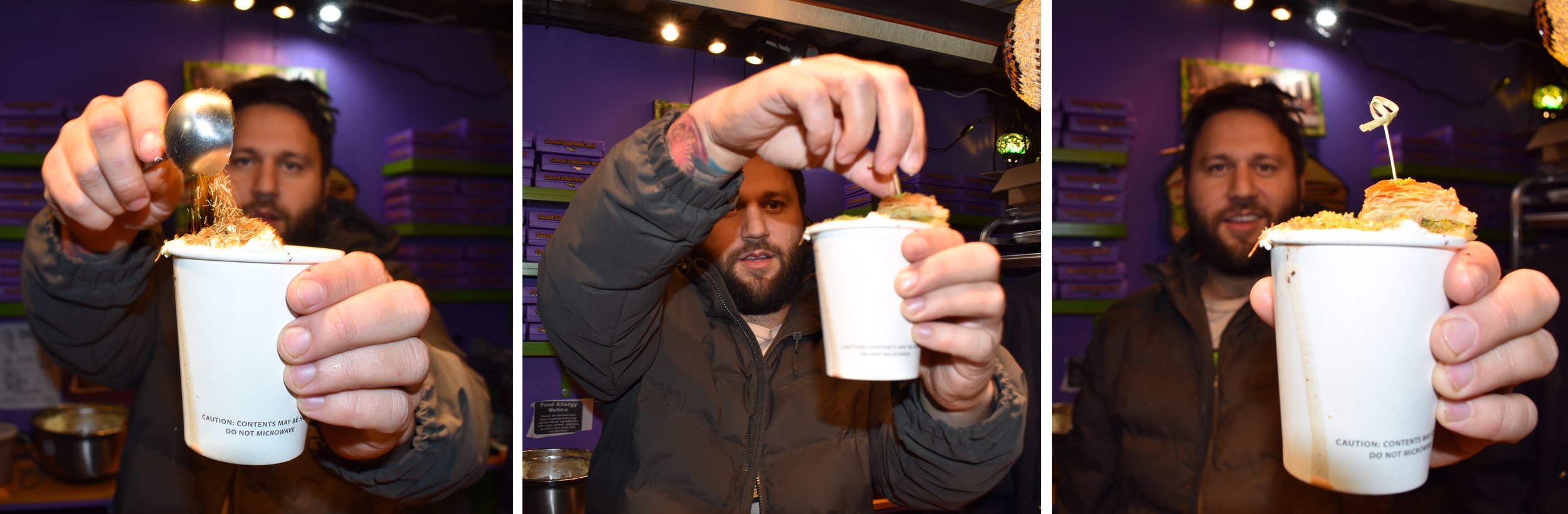
Donk making a Dubai hot chocolate. Photo: Nina Roberts
NR: Does anyone ever give you grief for selling baklava, not being Turkish, Greek or Middle Eastern?
RD: You always run into someone like that. My great-grandfather was from Cyprus, so I could claim some baklava connection. I’m also Jewish. I mean, baklava’s not a Jewish food, but there’s plenty of Jewish people in Greece and Turkey, it’s a Mediterranean sweet.
I usually try to slow the conversation down and talk through it. Like, “What’s the real issue with me selling baklava?”
I’m quite famous in Turkey, as the baklava guy of New York. I’m actually starting a little project, a petition. I’m collecting signatures of Turkish people that support Roy Donk, the white Jewish kid from the Kingdom of New Jersey, selling Turkish Baklava.
NR: That’s hilarious.
RD: The goal is to gather 1,000 signatures so if I run into the scenario where I get some pushback, I’ll bust out the petition.
NR: How was the Macy’s Holiday Square Market? I think you posted on Instagram that you spent $30,000 setting it up?
RD: We basically broke even. I didn’t get paid. I still have to run a final report, I’ve kind of been pushing it off, gathering the confidence for it. We definitely didn’t lose money, you know? I feel like we have the same amount of money in our bank account as when we started. We also have physical assets: a real industrial restaurant trash can, two fire extinguishers, a display case.
It was a great experience, there was media, like Good Day New York, and my personal views [on social media] are at like 1.1 million, with 1,300 new followers.
NR: Have you been hit by tariffs?
RD: Baklava prices haven’t been raised. I feel like my supplier kind of absorbed it because we order so much—it’s actually quite a competitive market. We got hit by other tariffs—pistachios and chocolate have gone up.
NR: What’s happening with Good Baklava in the future?
RD: I’m going to Turkey in a couple weeks, it’s my third trip there. My supplier is taking me to meet the mayor of the city where my baklava is made.
It looks like we’re going to get our own headquarters and it won’t be my apartment. We’re getting a Kosher certification. I’m working on a crazy baklava milkshake. There’s a good chance we’ll be at Smorgasburg and Queens Night Market.
I’d say we’re at the 20-yard line of how far I think this company could go. We have plans of expanding. The goal is 300 franchise stores. It was never supposed to get as far as it did, so I might as well take it as far as it’ll go.
This Q&A had been edited and condensed for clarity.